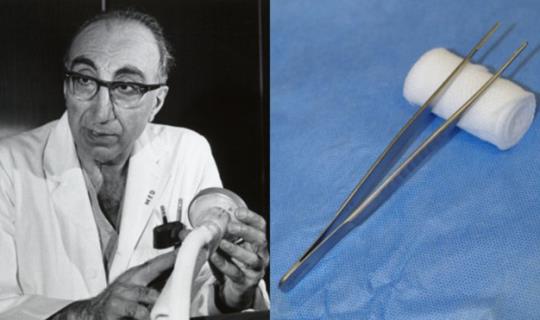
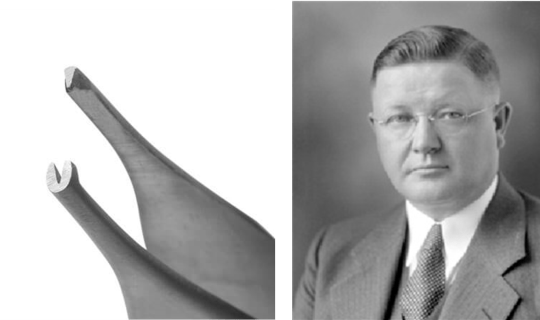
Surgeon behind the instrument - Halsted Mosquito forceps
By Ray Kudej, DVM, PhD, DACVS
Many commonly used instrument names are eponyms; however, their origin is rarely considered. Below are brief portraits of a few people hiding behind the names of familiar surgical instruments.
FORCEPS. Latin forceps "something with which to grasp hot things”, a compound of formus "heat, warm" + root of capere "to hold, take, grasp." Originally a smith's implement. https://www.etymonline.com/word/forceps.

Halsted Mosquito Forceps: William Stewart Halsted (1852–1922)
“The only weapon with which the unconscious patient can immediately retaliate upon the incompetent surgeon is hemorrhage.” William Stewart Halsted
William Halsted is considered the father of modern American surgery. Halsted began his studies at Yale, where he was better known for his athletic than academic ability. He graduated from New York College of Physicians and Surgeons in 1877. He began his career at Presbyterian Hospital in New York, then left to complete his training in Europe, notably in Vienna. There he learned aseptic surgical technique and hemostasis by pliers, each unknown in America.
In 1882, Halsted had the hubris to perform the first recorded surgical removal of gallstones. Halsted’s mother was visiting his sister in Albany when she became extremely sick. Halsted was called upon to see her. After diagnosing an acutely inflamed gallbladder, he placed his mother on the kitchen table, anesthetized her with ether, dipped his hands and instruments in carbolic acid, opened his mother's abdomen, removed seven gallstones and saved her life. Similarly, the first recorded blood transfusion in an emergency was also performed by Halsted, in Albany, when his sister began to hemorrhage after giving birth. While her husband, a physician, and the obstetrician were trying to stop the bleeding with ice and gauze she became weak and pale, i.e., going into shock. Halsted injected blood from his own veins directly into her veins; and it was claimed that she perked up and this saved her life.
In 1884 Halsted had learned of cocaine hydrochloride being used as a local anesthetic in Austria. Consistent with the era, he used himself and his students and colleagues at Columbia to evaluate the placement and effectiveness of cocaine nerve blocks. Many became addicted, including himself, and some died from overdose. This was a career setback. He stayed in a sanatorium, the Butler Hospital in Providence, RI, for several months, where his addiction was treated with morphine. He would remain dependent on both substances throughout his life.
A friend at Johns Hopkins Hospital brought Halsted to Baltimore. Managing and concealing his addictions, Halsted earned a reputation as an enigmatic recluse. Also at Johns Hopkins, Halsted attained greatness and transformed the entire field of surgery.
In 1889 Halsted became the director of the surgery department at John Hopkins Hospital, then the first professor in 1892. He established a teaching model within a setting of progressive practice, similar to the boarding of surgery as we know it. Virtually all professors of surgery through the end of the 20th century in America could trace their academic training to Halsted. Even to this day, surgical training at all levels includes “Halsted’s Principles”: Gentle tissue handling; Control of hemorrhage; Preservation of blood supply; Strict asepsis; Minimize tissue tension; Accurate tissue apposition; Elimination of dead space; Importance of rest.
Over the course of his career, Halsted contributed to a long list of medical advancements, including innovations in operating-room hygiene, hernia surgery, thyroidectomies, vascular aneurysms, wound healing, and (of course) the techniques for gentle handling of tissues and organs in an age that emphasized surgical speed. In 1898 Halsted perfected the radical mastectomy, extending the lives of breast-cancer patients, and was a pioneer in local anesthesia.
He also invented surgical gloves, which had more to do with protecting the hands of his future wife than germ theory. In 1894, about 50 percent of surgeries were fatal for the patient. This is because handwashing didn’t necessarily take place between surgeries or exams, so patients were constantly being exposed to new germs and bacteria.
In 1890, Chief nurse Caroline Hampton developed a skin rash on her hands and arms working with mercuric chloride during surgeries. These chemicals were used to kill germs, but Hampton had developed a contact reaction.
Hampton showed her condition to Dr. Halsted, who was the surgeon she worked with. (Dr. Halsted described her as having “gentle blood”. They would later marry.) Dr. Halsted worked out some designs with the Goodyear Rubber Company and requested two pairs of rubber latex gloves be made. The gloves produced were not like the stretchy and thin disposable gloves used today, but they were considered to be thin at the time.
Soon all of Halsted’s surgical team were wearing gloves during surgeries. However, the primary benefit was thought to be increased dexterity during operations; Preventing the spread of germs and bacteria was not the primary consideration. Dr. Halsted himself did not begin consistently wearing the gloves until 1896.
Dr. Halsted died in 1922 as a result of cholangitis and was buried in Brooklyn, New York. He had never been able to get rid of his addiction.
Gerald Imber, author of Genius on the Edge: The Bizarre Double Life of Dr. William Stewart Halsted.
NPR: Fresh Air Episode. Re-Examining The Father of Modern Surgery. Author interview with Gerald Imber. FEBRUARY 22, 2010. https://www.npr.org/transcripts/123570287?ft=nprml&f=138112624
https://glovenation.com/blogs/news/the-invention-of-surgical-gloves