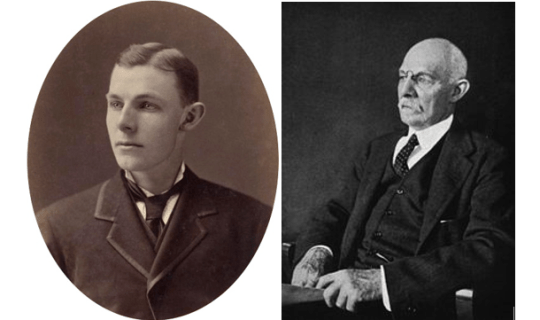
Surgeon behind the instrument - Adson forceps
By Ray Kudej, DVM, PhD, DACVS
Many commonly used instrument names are eponyms; however, their origin is rarely considered. Below are brief portraits of a few people hiding behind the names of familiar surgical instruments.
FORCEPS. Latin forceps "something with which to grasp hot things”, a compound of formus "heat, warm" + root of capere "to hold, take, grasp." Originally a smith's implement. https://www.etymonline.com/word/forceps.

Adson forceps: Alfred Washington Adson (1887–1951)
Quote from A. Earl Walker (professor of neurological surgery from 1947-1972, Johns Hopkins Hospital): “Although neurological surgery may have been conceived in England and spent its infancy in Europe, there is no doubt that it passed a stirring adolescence and came of age in the United States of America. To Harvey Cushing belongs much of the credit for the guidance of the growing specialty through its formative years. The growth of neurological surgery was not confined to the New England States of America—Frazier, Dandy, Sachs, Adson, Naffziger and others in widely separated parts of the country were aiding in the maturation of the specialty.”
Alfred Adson was born in a small town in northwest Iowa. His parents were immigrants from Norway, his father was a Norwegian sailor before becoming a farmer. After attending the University of Nebraska, Adson received his medical degree at the University of Pennsylvania in 1914. He then became a fellow in general surgery under the direction of William and Charles Mayo at the Mayo Foundation in Rochester, MN.
Quote from Alfred Adson: “On July 1, 1914, having just been graduated in medicine from the University of Pennsylvania, I was admitted to the Mayo Foundation for a three-year course in general surgery. At that time I had no interest in neurosurgery nor did I ever suspect that I should devote my full time to neurosurgery.”
In 1917 an eminent British Military surgeon having seen Adson resecting a spinal meningioma described him as, "a high school boy performing neurosurgery”.
In 1921, William Mayo made Adson professor and head of the Department of Neurosurgery, a department which didn’t exist. Adson created and headed the department until 1946, when he became senior neurosurgeon.
Most of the original surgeons who developed neurosurgery realized the need for special instruments to facilitate exposure, hemostasis and delicate tissue handling. Adson devised various instruments that bear his name, with the most widely recognized being the Adson forceps.
Reminiscing about the founders of the Society of Neurological Surgeons, Dr. Frank Turnbull described his colleague Alfred Adson, as a “man of strong opinions who could be a gentle and gracious host or an explosive tyrant at times that were not predictable.” Adson, in Turnbull’s narrative, seemed to typify the strong personalities of most of the early neurosurgeons. [Frank Turnbull, “As It Was in the Beginning; an Essay to Commemorate the Fiftieth Anniversary of the Founding of the Society of Neurological Surgeons, March 1970,” inThe Society of Neurological Surgeons: Diamond Jubilee, ed. Eben Alexander (Winston-Salem, NC: Hunter Publishing Company, 1984), 5.]
Dr. Adson served as president of the Minnesota State Medical Association in 1937, and at different times he served on state committees having to do with university relations, social workers, medical economics, Minnesota Medical Service, insurance, public policy and the work of statewide congressional committees. At the time of the centennial of the state of Minnesota in 1949, Dr. Adson was selected as one of Minnesota's “One Hundred Living Distinguished Citizens.”
At an honorary dinner organized by his former fellows in neurosurgery for his retirement, Adson addressed the attendees and said, “I would rather you came to honor me now than to attend my funeral.”
Dr. Alfred Adson died acutely from a coronary occlusion on November 12, 1951, six weeks after this dinner in his honor.
Craig, WM. Alfred Washington Adson- Pioneer Neurosurgeon. Journal of Neurosurgery. 1952; Volume 9:117-123.