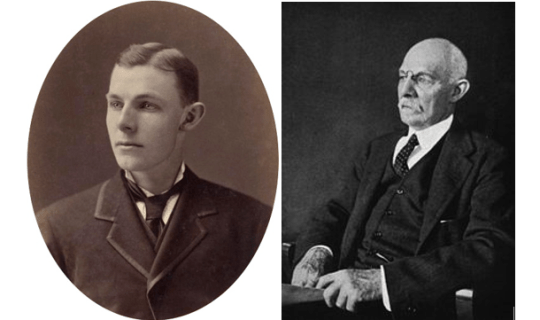
Surgeon behind the instrument - Debakey forceps
By Ray Kudej, DVM, PhD, DACVS
Many commonly used instrument names are eponyms; however, their origin is rarely considered. Below are brief portraits of a few people hiding behind the names of familiar surgical instruments.
FORCEPS. Latin forceps "something with which to grasp hot things”, a compound of formus "heat, warm" + root of capere "to hold, take, grasp." Originally a smith's implement. https://www.etymonline.com/word/forceps.

Debakey forceps: Michael Ellis Debakey (1908–2008)
Michael Ellis DeBakey was born in New Orleans to Shaker and Raheeja Dabaghi (Anglicized to DeBakey), Maronite Christians from Lebanon, who immigrated to the United States because of religious persecution back home. He was one of five children and credits his parents for teaching him the values of education and hard work and service to others, which led him to his successful career.
His parents settled in Lake Charles, LA, in French-speaking Cajun country. They owned rice farms, real estate and drug stores, which became hangouts for doctors. "I became enamored of them," Dr. DeBakey said.
He received his bachelor's and medical degrees from Tulane University in New Orleans. He began teaching at Tulane in 1937.
In the late 1930's, DeBakey and his mentor at Tulane University, Dr. Alton Ochsner, both non-smokers, became two of the first scientists to link the early rise in lung cancer to cigarette smoking. At the time, other medical leaders attributed the cancer increase to factors like the 1918 influenza epidemic or inhalation of poisonous gases in World War I.
During World War II, DeBakey worked in Europe as director of the surgeon general's surgical consultant’s division, helping develop mobile army surgical hospitals (MASH units) and specialized treatment centers for returning veterans. He returned to Tulane after the war and joined Baylor University College of Medicine in Houston in 1948. Under his leadership as Chair of the Department of Surgery, during the 1950s Baylor became a worldwide leader in the field of cardiovascular surgery.
DeBakey's mother taught him to sew. In the early 1950's, using his wife’s sewing machine, he drew on that know-how to make vascular grafts from Dacron and use them to repair aneurysms of the aorta. Such grafts are now part of standard treatment.
"I really opened that field," DeBakey said.
His inventions like the roller pump, used in heart-lung machines, have become standard in medicine.
Peers acknowledged DeBakey's many talents, as well as his ample pride.
"No question, he has a pretty big ego," said Dr. Claude J. Lenfant, the head of the National Heart, Lung and Blood Institute. But, Dr. Lenfant added, "his contributions have been enormous and he will leave an amazing legacy."
Debakey was known for wearing white cowboy boots in the operating room, working 16 hour days, sleeping little, eating light and shunning exercise. He had his own custom boot maker, and his boots were unique. For the last 30 years of his life, his boots were of only one design. He wore lighter color boots in the operating room and on rounds, but darker, usually black boots, when he was not wearing surgical scrubs. At the age of 90, still performing surgeries, Debakey said he eats whatever he wants but is a light eater and often skips lunch because of work. He said he has never deliberately exercised, rarely takes vacations and last visited his 1,000-acre ranch in the nearby Texas hill country two years ago. "Man was born to work hard," Debakey said.
Around Baylor, DeBakey's inexhaustible energy has led to the nickname "The Texas Tornado," and his high standards and sometimes harsh demeanor have intimidated some staff members. When young doctors failed to meet his expectations, DeBakey said, he would lecture them: "You have four fingers and a thumb like I do. Why can't you use them the way I do?"
Asked about his reputed temper, DeBakey said in his Louisiana drawl, "Maybe I should be more compassionate with people who do not think as fast as I can." But he added, "I have little tolerance for incompetence, sloppy thinking and laziness."
"He had a burning desire to reach the top and be recognized as the leader in his field. He wanted to be a leader and an inspirer." "He was a rather stern disciplinarian in many respects, and a somewhat different personality from my own. But I respected the constant devotion to his work. He had very few hobbies.”
-- Dr. Denton A. Cooley, famed Houston heart surgeon, one-time DeBakey associate and longtime professional rival.
https://3quarksdaily.com/3quarksdaily/2008/07/michael-e-debak.html
https://archive.nytimes.com/www.nytimes.com/library/national/science/090198sci-debakey.html
https://www.cbsnews.com/news/famed-heart-surgeon-michael-debakey-dead/
https://app.texmed.org/tma.archive.search/7020.html